A Rainy Afternoon, One Question, and Scrap Paper
Explore scrap paper tearing direction by comparing edges from one sheet and recording clear observations, without mistaking a handful of scraps for a rule.
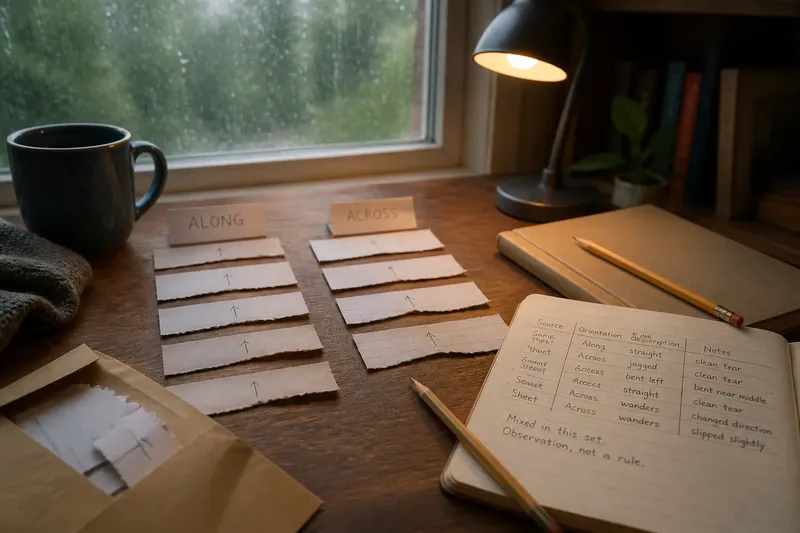
Scrap paper tearing direction is easiest to observe when you keep track of which way each piece faced. Use strips from one sheet, mark their orientation, and compare the torn edges. The result describes those scraps, not every sheet of paper ever made.
You need plain paper, scissors if you want matching starting strips, a pencil, and an envelope for notes. Notebook or printer paper works. Leave glossy packaging, tissue, and thick card out of this comparison; their different construction would muddle the question.
What does tearing direction mean here?
Ask a narrow question: Does tearing this paper parallel to a reference mark leave a different-looking edge from tearing it across the mark? You can compare whether each edge looks straight, jagged, or prone to changing direction.
On lined paper, use the printed lines as a reference. On blank paper, draw an arrow along one edge of the sheet before making strips. Mark the strips too, so the reference survives after they move around.
Which paper should you use?
Use pieces from the same sheet if possible. Set aside any strip with a fold, tape, water mark, torn corner, or heavy printing where the tear will run. Those features might affect the edge, and they give you another question you did not ask.
Make a small group of strips that are roughly similar in width and length. They need not match exactly, but an obviously narrower strip is a poor comparison partner. Do not use paper with staples or other attached hardware.
How do you prepare and tear the strips?
- Mark an arrow on each strip to show its reference direction.
- Sort the strips into two piles: planned tears parallel to the arrow and planned tears across it. Label the piles “along” and “across,” not “easy” and “hard.”
- Start each tear at the same kind of edge and pull toward the opposite side with a similar grip.
- Alternate between piles, placing each torn piece beside its starting strip. If a strip slips or catches on a fold, set it aside and note why.
Alternating helps keep your handling reasonably similar from one group to the other. There is little value in tearing a large stack just to produce more edges to sort. A few pieces in each pile are enough to begin looking.
What should you write down?
Describe what another person could check by looking at the edge. “The edge bent toward the left near the middle” is more useful than “this way was worse.” Use the same terms for both piles.
- Paper source: Check whether each strip came from the same sheet; if not, keep sources separate, or compare only strips from one sheet.
- Orientation: Check that the arrow or lines identify the planned tear; if the mark is missing, set the strip aside, or remark it before tearing.
- Edge path: Check whether the edge looks straight, jagged, or changed direction; if one description fits, record it, or sketch the path when words are too broad.
- Handling: Check for a slip, fold, or hesitation; if one occurred, note it and set the strip apart, or retain it only as an observation marked unusual.
- Group comparison: Check whether the same visible feature appears repeatedly in one pile; if it does, plan a focused repeat, or record that the pattern was mixed if it does not.
- Notes and scraps: Check that each note stays with its matching strip; if the pairing is unclear, exclude that strip from the comparison, or restore the pairing using its mark before drawing a conclusion.
Say you have six strips from one plain sheet, three marked for each orientation. Two “along” edges look fairly straight and one bends; one “across” edge looks straight and two wander. Write down those observations and keep the strips with their notes. The answer for this set is mixed, so it does not support a claim that either orientation always makes a straighter tear.
How should you interpret the edges?
Put the pieces side by side under the same light. Look for a feature that appears more than once, then check how much the edges vary within each pile. A ruler might help align starting edges, but measuring every notch adds little to this visual comparison.
If the piles look alike, record that you did not notice a clear difference in this set. If one pile seems more consistent, call it an observation about these scraps, not a rule about paper. Sheet, finish, storage, and handling may all differ outside this comparison.
Not worth the effort: sorting scraps by tiny shade changes or naming every notch. If a detail does not help distinguish the two orientations, leave it out.
What do readers ask about paper tearing direction?
Can paper grain affect a torn edge?
Paper fibers can have a preferred direction, which may affect how a tear behaves. These scraps can show an edge difference, but they cannot identify its cause by themselves.
Should I cut the strips with scissors first?
Scissors can make comparable starting strips; use your hands for the edges you want to observe. Cutting those edges instead would replace the tearing question with a cutting one.
Can I compare notebook paper with packaging?
Keep different materials in separate groups rather than combining them. Coatings, thickness, and folds can add differences that have nothing to do with orientation.
What if both piles look the same?
Record that no clear difference stood out in this set. If you want to check again, use fresh strips from the same kind of paper and keep the new notes separate.
What is a useful next question?
Let the observation choose the follow-up. If edges vary within both piles, repeat with fresh strips from the same sheet type and use the same labels. If one group looks more consistent, repeat on another sheet of the same paper before changing materials. If paper type interests you, compare each type in its own pair of orientation groups.
Change the question deliberately. A comparison of lined and plain paper asks something different from a repeat on another sheet; combining both changes makes the result harder to read. For a scrap paper tearing direction note, keep the source, orientation, edge description, and any handling interruption together. That is enough to make the next observation clearer without turning the kitchen table into a laboratory.