The One-Change-at-a-Time Trap
The one-change-at-a-time method can hide interactions. Learn how to choose useful comparisons and keep conclusions tied to what you actually observed.
The one-change-at-a-time method can miss a useful clue: a feature may behave differently when paired with another. If you are planning a small materials experiment, choose comparisons that answer a real question, not every pairing that can fit in a table.
What can one comparison tell you?
Changing one feature while keeping others as steady as practical helps narrow the possible explanations for an observed difference. It does not show that the feature acts independently in every setting.
Say you compare a paper strip and a strip with a row of small cuts, both hung from the same kind of clip. If the cut strip opens into a different shape, you can describe that result for this setup. You cannot infer from it how the cuts would behave in a damp sheet, a folded sheet, or a different arrangement.
This kind of comparison is useful when you are learning to observe a material or need a clear first description. It is less useful when your real question concerns how two features work together.
When is a single-feature comparison enough?
Use one when the next decision concerns one defined arrangement. If you are choosing which of two materials to use for a particular craft, compare them in that craft rather than trying to make a rule about materials in general.
It is also a sensible choice when the observation itself is unclear. Adding more combinations will not help if you cannot describe what happened consistently. First settle on an observable distinction, such as whether a strip stays flat or curls after being released.
What is not worth the effort: a large grid of combinations when none of the extra results could change what you plan to do. A neat table is not a substitute for a useful question.
When should you compare combinations?
Compare combinations when you have a specific reason to suspect that one feature changes the effect of another. For instance, a paper fold may hold its shape differently depending on whether the sheet is smooth or textured. A comparison of folds using only one sheet type cannot address that possibility.
Start with the combinations tied to the decision. If you need to know whether two folds behave differently on two kinds of sheet, compare each fold with each sheet type. Record only what you observe; leave any unexamined pairing blank rather than guessing.
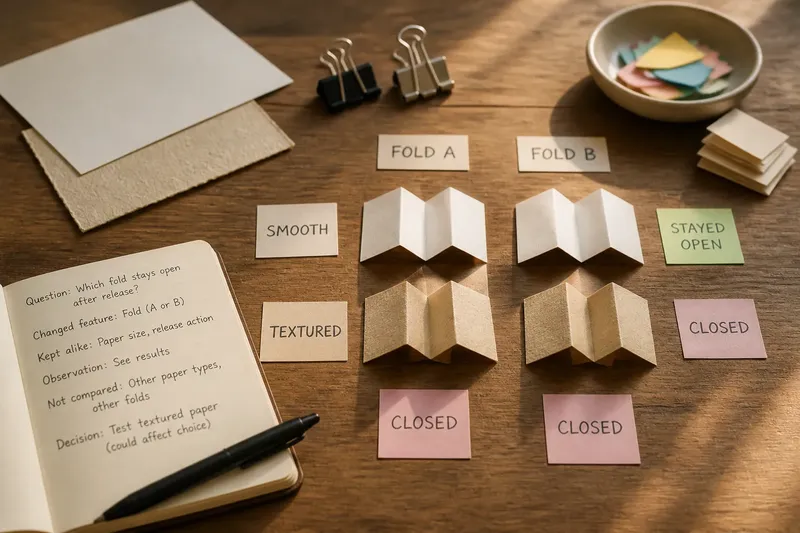
Imagine you have smooth and textured scrap paper, and you want to know which of two folds stays open after you release it. You make both folds with each paper type, using the same release action, then note whether each sample stays open or closes. If one fold stays open on both papers, that pattern supports a narrow description across those four pairings. If it stays open on smooth paper but closes on textured paper, the result suggests that paper type may matter to the fold comparison. Either way, the answer is about these materials and this action, not paper as a whole.
How do you choose the next comparison?
- Check whether you can describe the observation clearly. If you can name a visible result, proceed with a focused comparison; if not, simplify the setup and choose a clearer observation.
- Check whether the next decision concerns one fixed arrangement. If it does, compare the options in that arrangement; if it does not, identify which additional feature could change the decision.
- Check whether you have a specific reason to expect an interaction. If you do, compare the relevant combinations; if you do not, begin with one feature and keep the question narrow.
- Check whether the action can be described consistently. If it can, use that action for the comparison; if not, clarify the action before adding more combinations.
- Check whether an unresolved pairing could change your choice. If it could, compare that pairing next; if it could not, record it as unexamined and move on.
- Check whether your claim would extend beyond the materials and arrangement observed. If it would, narrow the wording; if you need a broader claim, identify the additional conditions that would need comparison.
How should you record a limitation?
Separate what you saw from what you think it means. “The strip curled after release” is an observation. “The cuts make paper more flexible” is an explanation that may need a different comparison.
A brief record can include:
- Question: What did you want to find out?
- Changed feature: What differed between the samples?
- Kept alike: What did you try to keep the same?
- Observation: What visible or otherwise directly noticeable result occurred?
- Not compared: Which relevant condition remains open?
- Decision: Does that open question affect what you will do next?
For the fold comparison, a record might say: “Both folds were made with smooth scrap paper and released in the same way. One stayed open; the other closed. Textured paper was not compared, so this observation does not tell us whether the difference holds for that material.” The note states what happened and what the comparison leaves unanswered.
What questions help you choose?
Does changing one feature prove that it caused the result?
It narrows the comparison by reducing the number of features that differ, but it does not establish a universal cause. Tie the claim to the setup and the observation.
When should I compare combinations?
Compare them when the decision involves features together or when a specific observation gives you reason to suspect they interact. Choose the pairings that could answer that question.
What if observations differ across materials?
Name the materials and arrangements that produced the differing observations. Then say which other conditions remain unexamined, rather than turning a mixed result into a single winner.
Do I need to test every possible pairing?
No. Compare a pairing when its result could clarify the question or change the decision. Record other pairings as open questions if they matter later.
How broad should the claim be?
Match the claim to the comparisons you made. A single-feature comparison supports a statement about that feature in the described arrangement; a comparison of combinations supports a statement about the pairings you actually included.
For the search phrase “one-change-at-a-time method,” the useful lesson is not to abandon the method but to use it for the question it can answer. Name the materials, describe the observation, and add combinations only when they could alter the next decision. A small experiment becomes more useful when its limits are visible, not when its table is full.