Why Folded Paper Holds Its Shape
Why folded paper holds its shape is easier to see when you compare a ridge, a tube, and a flat sheet, then match the form to the direction of force.
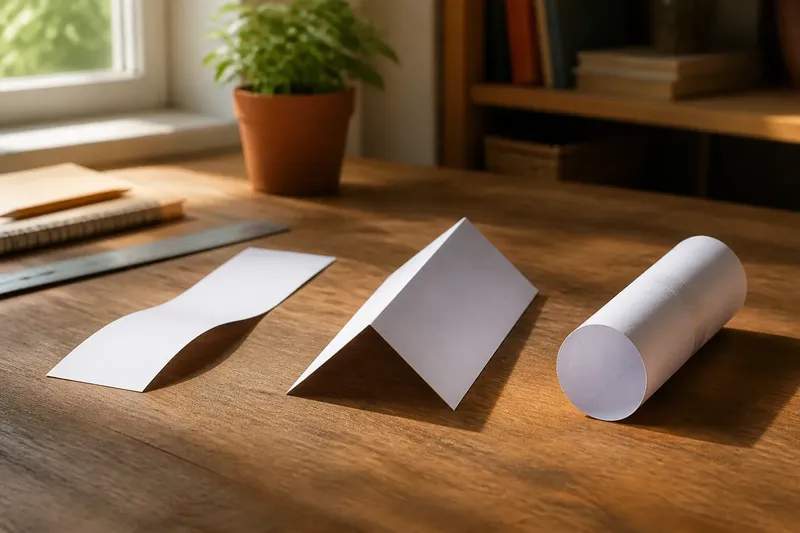
Why folded paper holds its shape is easiest to see in a small paper beam: a flat strip sags, while the same strip folded into a ridge resists bending across that ridge. The difference comes from geometry, not added material.
Why does a ridge resist bending?
A flat sheet is thin, so a push can make a broad area bow. Fold it into a shallow V and the sheet gains depth around a ridge. The sloping faces support one another, giving the paper a more defined shape to bend around.
That support is directional. A V may resist a push across its ridge but flex along it, or twist if the push is off-center. Folding changes how the paper responds; it does not make the sheet stronger in every direction.
Which paper shapes reveal the difference?
Three forms make useful comparisons, each answering a slightly different question:
- Flat strip: Shows how the paper behaves without a structural ridge.
- V-fold: Shows how one ridge changes bending across the strip.
- Paper tube: Shows how a curved, closed shape resists being pressed from the side. It is less convenient for observing a single crease, but useful when the question concerns a hollow form.
For a fair visual comparison, cut matching strips from one sheet of ordinary paper. Use a ruler and pencil to mark equal lengths and widths, then fold one strip lengthwise into a V. Leave another flat. To make a tube, curl a third strip and secure its edge with a small piece of tape. These forms are not interchangeable: the V highlights a ridge, while the tube distributes a side push around a curved wall.
Say you want a paper divider to stand upright on a desk. Imagine a flat strip that leans over when its edge is placed on the table. You fold a matching strip lengthwise into a V, set both in the same orientation, and see the folded one remain upright while the flat one bows. The result suggests that a ridge suits this particular support problem; it does not establish that a V-fold is best for every paper object.
How do V-folds, pleats, and tubes differ?
A V-fold makes one prominent ridge and two broad faces. It is easy to inspect and useful when a narrow spine is enough. Its response depends on push direction, so note whether pressure is applied across the ridge or along it.
An accordion fold adds repeated ridges and valleys. Those pleats can help a wider panel keep a profile or open and close along its folds. They also make the cause of a bend less obvious: several creases are involved, rather than one.
A tube has no single top ridge. Its curved wall spreads a side push around the shape, though the tube can flatten if pressed firmly or if its seam opens. Use it to explore curved hollow forms, not as a more complicated substitute for a simple V comparison. Making elaborate pleats is not worth the effort when one ridge answers the question.
What should you observe as the paper bends?
Look at the whole form, not only the crease. A strip may keep its ridge but bow between its ends. A tube may hold its curve yet flatten at one point. Note whether the form flexes and returns, stays bent, tilts, or loses its profile.
Use the same gentle touch and push direction for each form. Try pressure across the V ridge, then along it; for the tube, press on the side rather than the end. Stop before crushing a crease. A crushed fold records damage, not simply the way the shape responds under light pressure.
Which shape suits the question you have?
Match the form to the movement you want to resist. These checks keep the decision tied to an observable result:
- If a flat strip bows across its width, then try a V-fold; if the fold still bows, use a broader or differently supported form.
- If the V holds across its ridge but flexes along it, then turn the ridge to face the push; if the push must come from several directions, consider a tube.
- If a wide panel needs to open and close, then try an accordion fold; if it only needs a fixed spine, use a single V instead.
- If a tube flattens at one spot, then check whether its seam has opened; if the seam is intact, try a different tube diameter or a V-shaped support.
- If a crease is crushed or torn, then remake the strip before comparing; if the paper is only gently bent, record that change rather than treating it as an intact fold.
- If the form stands only when held at one end, then add support at the base or choose a shape that stands on its own; if it stands freely, record the orientation that worked.
What do readers ask about folded paper?
Does folding make paper stronger?
Folding adds no material. It changes how the paper resists bending, often making it stiffer in one direction while leaving it flexible in another.
Why does a flat sheet bend so easily?
A flat sheet has little depth, so it can bow across a broad area. A ridge or curve changes the geometry and gives bending a more defined path.
Is an accordion fold stiffer than a V-fold?
Neither is stiffer in every direction. An accordion has several ridges and may suit a wider panel, while a V-fold gives one clear ridge to inspect.
What paper works for this comparison?
Ordinary paper that holds a visible crease is enough. If one strip is much thinner or thicker than the others, the comparison also reflects a material difference, not just a change in shape.
Why folded paper holds its shape becomes clearer when you distinguish a ridge from a tube and pay attention to the direction of the push. Choose the simplest form that addresses the movement your object needs to resist; extra creases are useful only when they change that answer.